

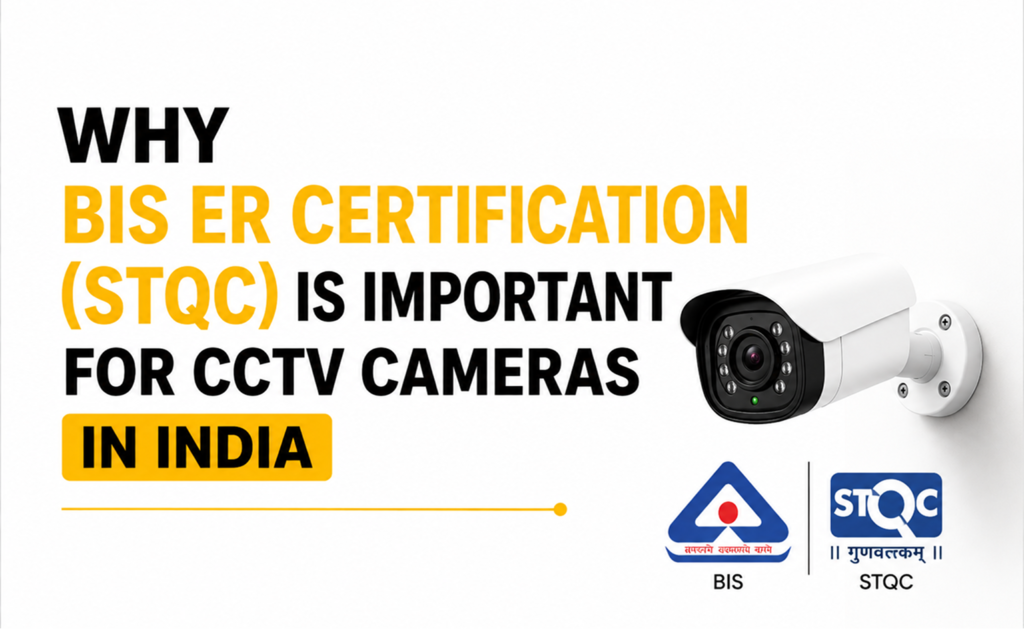
Why BIS ER Certification (STQC) is Important for CCTV Cameras in India
Why BIS ER Certification (STQC) is Important for CCTV Cameras in India Introduction Over the past decade, the role of Closed-Circuit Television (CCTV) cameras in India has transformed dramatically. What was once viewed merely as a passive monitoring tool for catching shoplifters or deterring trespassers is now a critical pillar of enterprise security, smart city infrastructure, and national defense. As CCTV systems evolved from closed analog loops to internet-connected digital networks, they brought unprecedented convenience—but they also opened the door to severe cybersecurity vulnerabilities. An unsecured network camera can easily become a gateway for hackers to infiltrate corporate networks, spy on sensitive operations, or launch massive botnet attacks. Recognizing these vulnerabilities, the Government of India, through the Ministry of Electronics and Information Technology (MeitY), stepped in to regulate the surveillance landscape. MeitY introduced the “Essential Requirements (ER) for Security of CCTV Cameras,” bringing them under the Bureau of Indian Standards (BIS) Compulsory Registration Order (CRO). To validate that a camera meets these stringent security standards, it must undergo rigorous testing by the Standardisation Testing and Quality Certification (STQC) Directorate. The mandate is clear: CCTV cameras are no longer just feature-driven hardware; they are regulated network devices. With strict deadlines approaching to phase out non-compliant stock, the transition to certified surveillance is non-negotiable. Whether you are a business owner, a system integrator, or an IT head, understanding this regulatory shift is crucial. Here is a deep dive into why BIS ER Certification and STQC testing are absolutely vital for CCTV cameras in India today. 8 Reasons Why BIS ER Certification and STQC are Critical 1. Robust Protection Against Cyber Threats and Hacking The most immediate benefit of BIS ER and STQC certification is the fortification of cameras against cyberattacks. Uncertified, cheap imports are notorious for shipping with easily exploitable vulnerabilities, hardcoded default passwords, and hidden backdoors. Hackers routinely scan the internet for such weak devices to hijack them for malicious purposes. Under the Essential Requirements (ER), a certified CCTV camera must have secure default settings, meaning users are forced to create a strong, unique password upon initial setup rather than relying on a shared default. Furthermore, STQC testing actively looks for hidden access points and vulnerabilities in the firmware. By mandating these baseline security measures, certification ensures that your surveillance system acts as a protective shield rather than the weakest link in your IT infrastructure. 2. Ensuring Legal Compliance and Avoiding Penalties The regulatory landscape in India is shifting from voluntary compliance to mandatory enforcement. CCTV cameras are now formally covered under the BIS Compulsory Registration Scheme (IS 13252) alongside the new cybersecurity ERs. The government has set firm deadlines after which the sale, distribution, and installation of non-compliant cameras will be strictly prohibited across the country. For businesses and installers, ignoring these mandates carries significant legal and financial risks. Procuring or deploying uncertified hardware can lead to hefty penalties, the confiscation of equipment, and the forced ripping-out of installed systems. Ensuring that every camera you purchase carries a valid BIS Registration Certificate (RC) number and STQC approval is the only way to safeguard your investments and stay on the right side of the law. 3. Safeguarding Sensitive Data and Video Privacy Surveillance cameras constantly capture highly sensitive data, ranging from employee movements and manufacturing processes to customer behaviors and secure facility layouts. If this video feed is intercepted during transmission, the privacy breaches can be catastrophic for an organization’s reputation and operations. BIS ER certification tackles this by mandating strong data protection mechanisms. Certified cameras must utilize encrypted communication protocols (such as TLS or HTTPS) for all data moving between the camera and the Video Management System (VMS) or Network Video Recorder (NVR). This end-to-end encryption ensures that even if a bad actor manages to intercept the network traffic, the video feed remains unreadable and secure. STQC testing validates that these encryption standards are not just promised on paper, but correctly implemented in the device’s software. 4. Hardware Integrity and Tamper Resistance While much of the focus is on software vulnerabilities, physical hardware tampering is an equally dangerous threat. Sophisticated attackers with physical access to a camera can extract firmware, steal encryption keys, or manipulate the device using exposed physical ports on the circuit board. The ER guidelines require CCTV cameras to be resilient at the hardware level. This includes disabling unprotected debug and test ports (like UART or JTAG) that are typically used during manufacturing but are a massive security risk if left open in a finished product. Additionally, STQC standards look for secure boot processes, which verify that the camera only boots up using digitally signed, authentic firmware from the manufacturer. These hardware-level defenses make it incredibly difficult for attackers to compromise the physical unit. 5. Essential for Government and Enterprise Procurement If your business involves supplying equipment to government bodies, Public Sector Undertakings (PSUs), or participating in tenders on the Government e-Marketplace (GeM), certification is no longer optional—it is a strict prerequisite. The government has mandated that only STQC-certified and BIS-ER compliant cameras can be utilized in public infrastructure projects, smart city deployments, and sensitive installations. This trend is rapidly spilling over into the private sector. Large enterprises, multinational corporations, and housing societies are increasingly updating their vendor policies to mirror government standards. Choosing uncertified surveillance brands effectively locks a business out of lucrative contracts and large-scale projects. Adopting certified cameras ensures total market eligibility and prevents project rejections based on compliance failures. 6. Transparency in Supply Chain and National Security Surveillance is inherently tied to national security. Over the years, intelligence agencies globally have raised alarms about foreign-manufactured surveillance equipment secretly routing data to overseas servers. To combat espionage and unauthorized data harvesting, India’s regulations demand complete transparency regarding a product’s origins. The BIS ER framework requires manufacturers to declare their software and hardware Bill of Materials (BoM). This means the origins of the System-on-Chip (SoC), image sensors, and memory units are documented and scrutinized. Furthermore, the certification process ensures that the camera