

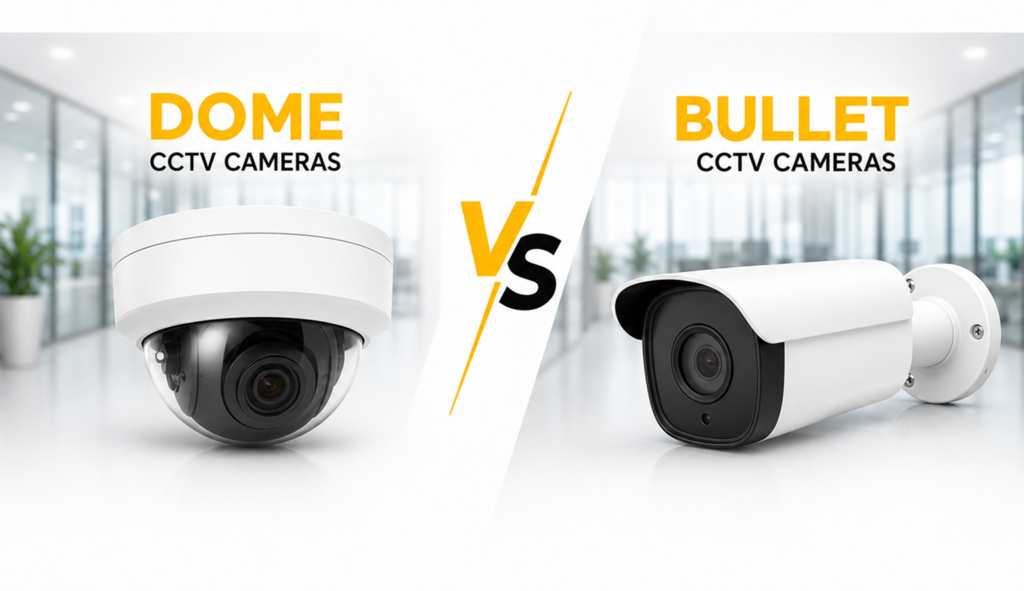
When you are choosing security cameras, the decision between dome and bullet models is about much more than just aesthetics. It is a choice between two completely different security strategies: discretion versus deterrence.
While they can contain the exact same image sensors, processors, and lens quality inside, their physical designs make them behave very differently out in the field.
Dome Cameras: Discreet and Vandal-Proof
Dome cameras get their name from their circular, dome-shaped protective housing. They are designed to blend seamlessly into their surroundings.
The Psychological Trick: Because of the smoked or reflective glass dome cover, it is incredibly difficult for someone standing below to see exactly where the camera lens is pointing. This creates a natural psychological barrier; people have to assume they are being watched from every angle.
Vandal Resistance: This is where domes shine. Their low-profile, rounded design means there is nothing for a vandal to grab onto, hook a rope around, or easily knock out of alignment with a stick. Many carry an IK10 impact rating, meaning they can survive a direct hit from a baseball bat or brick.
Best Suited For: Low ceilings, indoor retail spaces, office lobbies, front porches, and any low-mounting height areas vulnerable to physical tampering.
Bullet Cameras: The Ultimate Visual Deterrent
Bullet cameras feature a highly visible, cylindrical design that projects outward from the wall, looking like a miniature telescope pointing directly at a target.
Active Deterrence: A bullet camera does not hide. Its physical presence screams “this property is protected.” If your goal is to stop a crime before it happens by making intruders think twice, the aggressive posture of a bullet camera is your best tool.
Superior Range and Versatility: Because bullet housings are larger, they often accommodate larger telephoto lenses, stronger infrared LEDs for longer night vision (up to 150–300 feet), and easy physical adjustment knuckles that allow them to be aimed in almost any direction.
Environmental Protection: Most bullet cameras feature a sliding “sun shield” lip over the top of the lens, which blocks lens flare from the sun and keeps rain droplets off the glass faceplate.
Best Suited For: Long driveways, large parking lots, high outdoor building corners, perimeter fences, and areas where you want a highly visible security presence.
Head-to-Head Comparison
| Feature | Dome Cameras | Bullet Cameras |
| Aesthetic Impact | Sleek, modern, unobtrusive | Industrial, highly visible, aggressive |
| Vandalism Risk | Very low (Highly resistant to impact and grabbing) | Moderate (Easier to knock down, cut, or redirect) |
| Night Vision Range | Typically shorter (50 to 100 feet) | Typically longer (100 to 300+ feet) |
| Installation & Aiming | Slightly harder (Requires mounting, opening dome, and aiming) | Very easy (Mount and adjust the external articulation joint) |
| Rain/Glare Protection | Susceptible to rain spots and dome reflections | Sun shield blocks direct rain and lens flare |
Which One Should You Buy?
To make the right choice, analyze where you are mounting the camera:
Buy a Dome Camera if:
You are mounting the camera within arm’s reach (under 10 feet), where someone could easily grab or hit it.
You want the security system to be unobtrusive and match clean interior decor (e.g., inside a home, restaurant, or retail store).
You want to keep people guessing about which specific zone the camera is monitoring.
Buy a Bullet Camera if:
You are mounting the camera high up on an exterior wall or pole (out of physical reach).
Your main priority is scaring off trespassers or vandals before they step foot on your property.
You need to monitor a long distance, like a long driveway, a fence line, or a wide-open backyard.