

RFID vs Biometric Access Control System, Which Is Better? Compare Features, Pros & Cons
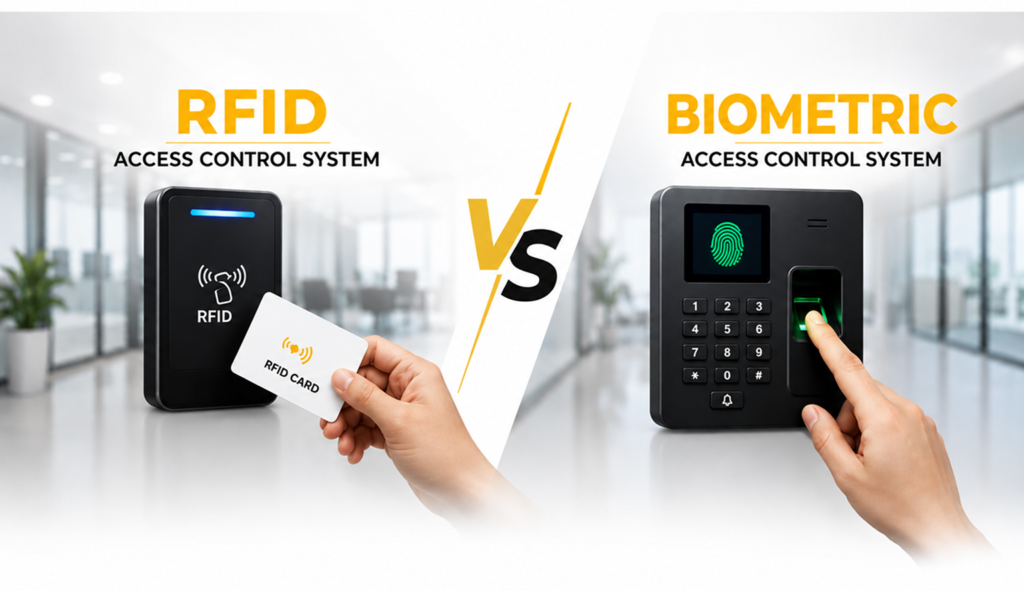
The Great Security Showdown: RFID vs. Biometric Access Control System
Introduction
Securing a modern facility is no longer just about heavy doors and physical keys. As businesses scale, threats evolve, and the need for seamless operational efficiency grows, organizations face a critical decision: how to effectively manage who enters which zone, and when. Two dominant technologies have emerged at the forefront of this security evolution: Radio Frequency Identification (RFID) and Biometric Access Control Systems.
While both systems serve the same ultimate purpose—restricting unauthorized access and protecting valuable assets—they operate on fundamentally different philosophies. RFID relies on what you have (a physical token, card, or key fob), whereas biometrics relies on who you are (a unique biological characteristic like a fingerprint, iris, or facial structure).
Choosing the right system is not a matter of finding the “absolute best” technology, but rather finding the best alignment for your specific organizational needs, budget, and operational environment. This comprehensive guide breaks down the features, pros, and cons of both systems across eight critical dimensions to help you make an informed decision.
1. Core Technology and Operational Features
H4: How RFID Systems Function
RFID access control systems utilize electromagnetic fields to identify and track tags attached to objects or carried by individuals. The system consists of three primary components: the RFID tag (embedded in a card, fob, or wristband), the reader, and the backend controller. When a user places their credential near the reader, the reader emits radio waves that activate the passive microchip inside the tag. The tag then transmits its unique identification number back to the reader, which verifies it against the database to grant or deny access. RFID operates across various frequencies, with high-frequency (13.56 MHz) and ultra-high frequency (UHF) systems offering encrypted communication and longer read ranges.
H5: How Biometric Systems Function
Biometric systems bypass physical tokens entirely by measuring and analyzing distinct human physiological or behavioral characteristics. The most common modalities include fingerprint scanning, facial recognition, iris scanning, and hand geometry. The system works in two distinct phases: enrollment and verification. During enrollment, the system captures a high-resolution scan of the user’s biological feature, extracts unique data points (such as minutiae points on a fingerprint or nodal points on a face), and converts them into a secure, mathematical template. When a user attempts access, the system performs a live scan, converts it into a temporary template, and matches it against the stored data in milliseconds.
2. Security and Vulnerability Levels
H4: The Vulnerabilities of Physical Tokens (RFID)
While RFID is highly effective for basic access management, its reliance on physical credentials introduces distinct security risks. The most prominent vulnerability is that RFID cards can be lost, stolen, borrowed, or copied. If an employee misplaces their badge, an unauthorized individual can easily gain access to the facility before the card is reported missing and deactivated. Furthermore, legacy low-frequency RFID systems (125 kHz) lack robust encryption, making them susceptible to “skimming” or “cloning” using cheap, readily available hardware bought online.
H5: The Unclonable Nature of Identity (Biometrics)
Biometrics offers a significantly higher baseline of security because biological traits cannot be easily transferred, forgotten, or shared. Employees cannot loan their fingerprint or retina to a coworker to log a shift early or enter a restricted zone. This completely eliminates “buddy punching” in time-attendance tracking and ensures absolute accountability. Modern biometric readers also incorporate liveness detection (such as pulse sensing or thermal imaging) to prevent spoofing attempts using high-resolution photographs, silicone molds, or synthetic models.
3. User Experience, Convenience, and Speed
H4: Frictionless Scanning with RFID
From a user perspective, RFID is incredibly intuitive and fast. Tapping a card or holding a key fob near a reader takes less than a second. It requires minimal user cooperation and functions perfectly regardless of environmental conditions or physical changes in the user. Furthermore, long-range UHF RFID systems allow for entirely passive access—meaning employees can pass through a barrier or turnstile with their badge still inside their wallet or pocket, maximizing throughput during peak traffic hours.
H5: Environmental Variables in Biometric Throughput
Biometric systems offer the convenience of never needing to carry a physical key, removing the hassle of locked-out employees. However, the authentication process can sometimes experience friction based on environmental or physical variables. A fingerprint scanner may struggle to read a finger that is wet, dirty, scarred, or extremely dry. Facial recognition systems can be impacted by drastic lighting changes, heavy eyewear, or protective face masks. These variables can result in False Rejection Rates (FRR), requiring users to retry scanning, which can slow down entry lines during morning rushes.
4. Implementation, Hardware, and Scalability Costs
H4: The Budget-Friendly Scalability of RFID
RFID systems feature a relatively low upfront hardware cost. Standard RFID readers are affordable and highly durable. However, the long-term operational cost of RFID lies in credential management. Organizations must continuously purchase, program, and distribute physical cards or fobs. As companies hire new staff, or when employees inevitably lose their badges, replacement costs compound over time. Despite this, for large enterprises with thousands of users, the initial deployment budget remains highly accessible.
H5: The Upfront Investment of Biometric Deployment
Biometric hardware is sophisticated and carries a significantly higher upfront purchase price compared to standard RFID readers. Devices featuring advanced facial recognition cameras, dual-spectrum illumination, or iris scanners represent a major capital expenditure. However, biometrics features an incredibly low long-term operational cost. Because the user’s body is the credential, there are zero ongoing expenses related to buying, replacing, or administrative printing of physical cards. Over a multi-year lifecycle, a biometric system can become highly cost-effective for static workforces.
5. Administrative Overhead and Card Lifecycle Management
H4: Managing the Logistics of Physical Assets
Operating an RFID system requires ongoing administrative upkeep. Security or HR teams must manage a constant lifecycle of issuance, collection, and deactivation. When an employee leaves the company, failing to retrieve their physical card creates an immediate security gap until it is manually purged from the system software. Additionally, visitor management requires maintaining a pool of temporary badges that must be carefully tracked, collected, and audited daily to prevent vulnerabilities.
H5: Streamlined Digital-Only User Rosters
Biometric systems dramatically reduce administrative friction by digitizing the entire credential workflow. Onboarding a new employee simply requires a brief scanning session to register their template. Offboarding is equally seamless: a system administrator can instantly delete or suspend the digital profile from a centralized server, revoking all facility access across multiple sites globally in real-time. There are no physical assets to track down, inventory, or replace.
6. Data Privacy, Compliance, and User Perception
H4: Low-Risk Anonymous Tracking with RFID
RFID systems inherently protect personal privacy because the physical cards carry no biological data. The RFID tag contains only an arbitrary identification number that maps to a profile in a closed, internal database. If a card is compromised outside the workplace, no personal or biological data can be extracted from it. Consequently, employee pushback regarding privacy concerns is virtually non-existent when deploying RFID systems.
H5: Navigating Biometric Data Privacy Regulations
Biometric systems face much stricter scrutiny regarding data privacy and regulatory compliance. Regulations such as the General Data Protection Regulation (GDPR) and the California Consumer Privacy Act (CCPA) classify biometric data as sensitive personal information. Organizations must ensure that their systems store data as encrypted, irreversible mathematical hashes rather than raw images of fingerprints or faces, making it impossible for hackers to reconstruct the original biological trait. Clear data governance policies, explicit employee consent, and transparent data deletion workflows are legally required to mitigate liabilities.
7. Environmental Resilience and Industrial Durability
H4: The Rugged Dependability of RFID Readers
RFID readers excel in harsh, unpredictable environments. The internal electronics can be entirely sealed in heavy-duty, weatherproof, and vandal-resistant enclosures (IP65 ratings or higher). Because the reading process is electromagnetic rather than optical, RFID systems operate flawlessly in heavy rain, sub-zero snowstorms, dust-choked construction zones, and pitch-black environments. They require virtually zero surface cleaning or maintenance.
H5: Keeping Biometric Sensors Clear and Calibrated
Biometric readers are generally more sensitive to environmental extremes. Optical fingerprint scanners require clean glass surfaces to capture accurate imagery, meaning grease, dirt, and condensation build-up can cause reading errors, requiring regular maintenance. While modern outdoor-rated facial recognition and iris scanners utilize infrared illumination to overcome harsh weather and darkness, they remain complex electronic devices that must be shielded from heavy downpours and physical impact to protect their optical lenses.
8. Hybrid Approaches: The Power of Multi-Factor Authentication
H4: Combining Both Worlds for High-Security Zones
For critical infrastructure, data centers, server rooms, and financial institutions, choosing between RFID and biometrics is a false dichotomy. Instead, high-security facilities implement Multi-Factor Authentication (MFA) by layering both technologies onto a single access point. In an MFA scenario, a user must first tap their corporate RFID badge (something they have) and then successfully pass a biometric facial or fingerprint scan (something they are) before the access control panel unlocks the door.
H5: Customizing Access Levels Across Your Facility
Implementing a hybrid architecture allows organizations to balance cost and security effectively across their entire campus. Low-risk zones—such as the main employee cafeteria, gym, or general office floors—can utilize cost-effective, high-throughput RFID readers. Meanwhile, high-risk perimeters—such as executive suites, research and development laboratories, and product inventory warehouses—can be secured exclusively behind biometric scanners or dual-authentication terminals.
Comparison Summary Matrix
| Feature / Criteria | RFID Access Control | Biometric Access Control |
| Primary Credential Type | Physical card, token, or key fob | Fingerprint, iris, face, or hand geometry |
| Security Level | Moderate (risk of lost, stolen, or cloned cards) | Exceptionally High (nearly impossible to replicate/share) |
| Upfront Hardware Cost | Low to Moderate | High |
| Ongoing Maintenance Cost | High (continuous replacement of cards/fobs) | Low (no physical assets to replace) |
| Throughput Speed | Extremely Fast (<1 second, consistent) | Fast (can vary based on environmental factors) |
| Administrative Overhead | High (card inventory management and tracking) | Low (purely digital database management) |
| Privacy Concerns | Negligible | High (requires strict compliance with data laws) |
| Environmental Durability | Excellent (unaffected by dirt, dust, or rain) | Variable (requires clean sensors and optimal lighting) |
Conclusion
When determining whether RFID or Biometric access control is the better choice, the decision ultimately rests on a clear assessment of your operational priorities, budget structure, and security architecture.
RFID Access Control remains the industry workhorse for organizations seeking an affordable, highly durable, easy-to-implement solution with rapid throughput. It is perfectly suited for commercial offices, schools, and industrial facilities where the primary goal is simple perimeter management and day-to-day traffic control, and where the risk associated with a lost or shared card is manageable.
Biometric Access Control represents the premier option for organizations where compromised access carries severe financial or security consequences. It provides absolute identity verification, eliminates the logistics of physical card lifecycles, and offers a futuristic, keyless experience for personnel. While it requires a larger upfront financial commitment and diligent data privacy governance, the elimination of credential sharing and physical key management delivers unparalleled peace of mind.
For the modern enterprise, the optimal path often involves a tailored mix: leveraging the high throughput of RFID for general entry points, while anchoring high-value rooms and restricted zones securely behind biometric identity verification.