

CCTV AMC (Annual Maintenance Contract)
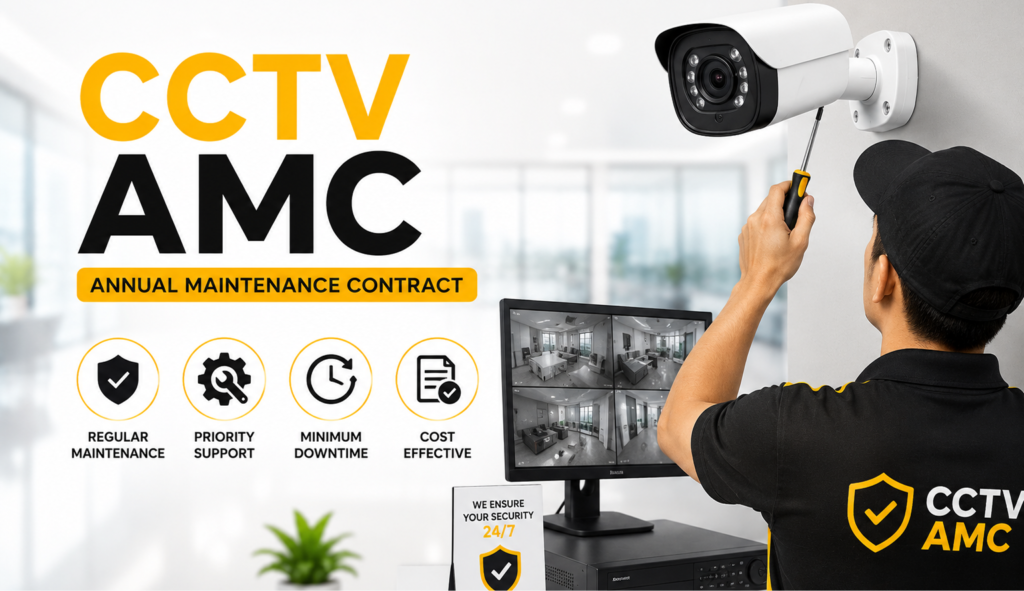
Maximizing System Uptime: The Complete Guide to CCTV Annual Maintenance Contracts (AMC)
Introduction
Installing a high-definition CCTV surveillance network is a major step toward securing your facility. However, a security system is only effective if it functions flawlessly when an incident occurs. Cameras exposed to the elements gather dust, electrical fluctuations stress power supplies, and hard drives spinning 24/7 eventually face wear and tear. Without regular upkeep, systems inevitably experience “blind spots” or recording failures—often discovered only after a security breach has occurred.
An Annual Maintenance Contract (AMC) is a service agreement between a business and a professional security systems integrator to provide scheduled preventive care, regular health audits, and rapid emergency troubleshooting for your surveillance infrastructure. For commercial enterprises, multi-site offices, and residential complexes, a structured CCTV AMC transitions your security strategy from reactive firefighting to proactive management, ensuring maximum system uptime.
1. Scope of Service: Comprehensive vs. Non-Comprehensive AMCs
H4: Comprehensive Maintenance Contracts
When signing a CCTV AMC, organizations must choose between two distinct financial and service models. A Comprehensive AMC acts as an all-inclusive insurance policy for your surveillance network. Under this contract, the service provider charges a fixed annual fee that covers all preventive maintenance labor, emergency call-outs, and the complete cost of replacing faulty hardware components—such as burnt power supplies, failed hard drives, or malfunctioning camera lenses. This model provides complete budget predictability, protecting organizations from unexpected capital expenditures if expensive hardware fails.
H5: Non-Comprehensive Maintenance Contracts
A Non-Comprehensive AMC operates purely as a labor and service agreement. The annual contract fee covers routine quarterly inspections, system cleaning, and priority technical support troubleshooting. However, if a camera sensor burns out or an NVR motherboard fails, the cost of the replacement hardware parts is billed separately to the client. This model carries a lower initial annual fee and is often favored by budget-conscious businesses with relatively new systems that are still covered under original manufacturer warranties.
2. The Architecture of a Preventive Maintenance Checklist
H4: Physical Hardware Diagnostics and Cleaning
Preventive maintenance is the core component of any AMC, typically executed on a quarterly schedule. Technicians follow a rigorous, structural checklist to keep hardware running at peak performance:
Camera Lens Care: Cleaning outer dome casings and lenses with specialized microfiber cloths and antistatic solutions to remove spider webs, dust, and water spots that degrade image quality.
Housing and Mount Inspection: Checking that mounting brackets, outdoor junction boxes, and conduits are structurally sound, tightly sealed against moisture, and free from physical corrosion.
Cable and Connector Audits: Inspecting exposed Ethernet or coaxial cable joints, checking for cable sagging, and ensuring RJ45 or BNC connectors are securely seated and free from oxidation.
H5: Digital, Storage, and Backend Maintenance
Beyond physical components, technicians dive into the digital configuration of your Network Video Recorders (NVRs) or Digital Video Recorders (DVRs):
Storage Health Analysis: Running S.M.A.R.T. diagnostic checks on surveillance hard drives to catch early signs of disk sector failure before video data loss occurs.
Firmware and Security Updates: Flashing recorders and IP cameras with the latest manufacturer firmware patches to close cybersecurity vulnerabilities and improve system stability.
Time and Sync Audits: Verifying that all devices are properly synced to a reliable Network Time Protocol (NTP) server. Inaccurate timestamps can completely invalidate video footage as legal evidence in a court of law.
3. Key Performance Indicators (KPIs) and SLA Commitments
H4: Defining Service Level Agreements (SLAs)
A professional CCTV AMC is bound by a legally enforceable Service Level Agreement (SLA). The SLA explicitly defines the standard of service the vendor must provide, ensuring accountability. It dictates how quickly a technician must respond based on the severity of the system failure. For instance, a single camera failure in a non-critical hallway might carry a 24-hour response window, whereas a complete NVR crash that blinds the entire facility would trigger a critical, high-priority emergency response window.
H5: Turnaround Time (TAT) and Loaner Unit Logistics
A critical metric in any SLA is Turnaround Time (TAT)—the duration between the initial fault report and the absolute resolution of the issue. If a faulty camera must be unmounted and sent to the manufacturer’s service center for repair, a strong AMC contract mandates that the vendor must temporarily install a free loaner camera in its place. This ensures that the facility’s security perimeter maintains zero blind spots while permanent repairs are being processed.
4. Financial Structure and Standard Pricing Models
H4: Per-Camera Pricing Architecture
For standard commercial offices, retail outlets, and small-to-medium enterprises, AMC pricing is typically calculated using a transparent per-camera model. The vendor evaluates the total node count of the system and charges a flat rate per camera line, which includes the backend recorder channel support. This rate varies depending on the technology used; digital IP cameras with advanced AI analytics carry a slightly higher maintenance premium than simple legacy analog cameras.
H5: Percentage of Capital Expenditure (CapEx) Model
For enterprise-grade installations—such as massive data centers, multi-floor corporate campuses, or public infrastructure—pricing is often structured as a fixed percentage of the total system installation cost. Typically, an annual AMC fee ranges between 10% to 15% of the initial hardware and infrastructure investment, depending on the age of the system, the complexity of the fiber-optic network backbone, and the intensity of the required SLA response windows.
5. Administrative Transparency: Checklists and Reporting
H4: Digital Maintenance Logs and Sign-Off Sheets
Transparency is essential for verifying that preventive care is actually being performed. After every scheduled AMC visit, technicians must fill out a detailed, itemized service report. Modern integrators use digital field-service applications that log the exact timestamp of the visit, track the specific voltage readings of the power supplies, and require a digital sign-off from the client’s facility manager. These records create a reliable operational history for the building.
H5: Incident Reports and System Auditing
When an unexpected hardware failure or security incident occurs, the AMC vendor provides an official incident report. This report documents the root cause of the failure (e.g., an external electrical surge or a mechanical impact), details the troubleshooting steps taken, and outlines long-term preventive recommendations. These audited maintenance logs are highly valuable when filing corporate insurance claims or proving regulatory compliance to external inspectors.
6. Managing the Lifecycle of Hardware and Obsoletion
H4: Proactive Lifecycle Planning
Every piece of security hardware has a finite operational lifespan. Surveillance hard drives typically run reliably for 3 to 5 years of continuous write cycles, while high-quality IP cameras can operate for 5 to 7 years before sensor degradation occurs. A core benefit of an AMC is that technicians track the age of your infrastructure, providing facility managers with early warnings and structured hardware lifecycle forecasts before mass failures occur.
H5: Managing End-of-Life (EOL) Equipment
As surveillance technology advances, older camera models are designated as End-of-Life (EOL) by manufacturers, meaning replacement components and security firmware patches are no longer produced. Under a long-term AMC, the service integrator works as a strategic partner to help transition your facility smoothly. They can design hybrid network architectures that allow legacy analog systems or EOL IP cameras to coexist with brand-new 4K cameras, stretching your security budget efficiently.
7. Cybersecurity and Network Infrastructure Maintenance
H4: Hardening the Surveillance Network
Modern CCTV systems are digital IP networks that connect directly to corporate servers and the internet for remote mobile viewing. This connectivity makes them potential targets for cyberattacks if left unmonitored. During scheduled AMC audits, network technicians review the system’s cyber security posture by changing default device passwords, disabling unused network ports, and checking that the surveillance traffic is properly isolated within a dedicated Virtual Local Area Network (VLAN) to prevent unauthorized internal access.
H5: Auditing Remote Access and User Permissions
Over the course of a year, an office experiences staffing changes, promotions, and employee offboarding. A critical part of the digital AMC audit involves reviewing the user access list on the NVR software. Technicians work with HR logs to delete legacy user accounts, update passwords for existing security staff, and ensure that remote mobile viewing privileges are restricted exclusively to current, authorized personnel, preventing accidental data leaks.
8. Hybrid Asset Management: Expanding Beyond Cameras
H4: Maintaining the Power Infrastructure (UPS and PoE)
A CCTV system is only as reliable as the power grid backing it up. AMC technicians perform deep checks on your Uninterruptible Power Supply (UPS) systems—testing battery health, conducting load drop tests to ensure the batteries can sustain the network during a blackout, and replacing aging battery cells. They also audit PoE network switches to ensure the total wattage output matches the power demands of your cameras when heavy infrared night-vision LEDs kick in at sunset.
H5: Integration Audits with Access Control and Alarms
In highly secure office spaces, CCTV systems do not operate in a vacuum; they are integrated with access control doors, motion sensors, and fire panels. During an AMC service visit, technicians conduct end-to-end integration tests. They verify that if a “Door Forced Open” alarm is triggered on an access gate, the central management software automatically commands the nearest PTZ tracking camera to pivot, focus, and record the incident, providing a seamless, automated security loop.
Service Comparison: Choosing the Right AMC Structure
| Service Feature | Comprehensive CCTV AMC | Non-Comprehensive CCTV AMC |
| Annual Contract Cost | Higher Upfront Cost | Lower Upfront Cost |
| Labor & Service Visits | Included (Unlimited Call-outs) | Included (Standard Scheduled Visits) |
| Faulty Camera Replacements | Included (No Extra Charge) | Billed Separately at Market Price |
| Hard Drive / NVR Repairs | Included (No Extra Charge) | Billed Separately at Market Price |
| Budget Predictability | High (Fixed annual expense) | Variable (Subject to sudden hardware costs) |
| Best Suited For | Large enterprises, mission-critical zones, aging systems | Startups, new installations under warranty, small retail shops |
Conclusion
An Annual Maintenance Contract is not an unnecessary operational expense; it is a vital investment that protects your initial security capital expenditure and guarantees operational continuity. A beautiful 4K camera network is completely useless if a hard drive failure went unnoticed for weeks, leaving you with zero footage when a critical incident occurs.
For small, budget-conscious offices with new hardware, a Non-Comprehensive AMC provides the necessary professional labor, routine cleaning, and firmware updates required to keep the system running smoothly while relying on factory warranties for hardware protection. However, for large commercial operations, data centers, and multi-site tech corporations where surveillance downtime carries severe financial or legal risks, a Comprehensive AMC provides unparalleled peace of mind, delivering rapid resolution times, seamless loaner hardware, and absolute budget predictability year after year.